古色 Patina
古色蒼然というと非常に古くて色あせた様子という意味で、あまり良い意味がなさそうですが、骨董品の世界では、古色には悪い意味はありません。
日本の骨董品の世界などでは、「この井戸茶碗の見込みのシミが良い景色になっていますね」などと言い、ここで言う景色は古色に近い意味です。
西洋アンティークの世界などでも、”Nice patina”などと言い、良い意味に使います。
Patina(パティーナ)とは狭義には緑青のことですが、広義では古色とか風格というような意味を持ちます。
ところが、これが人間のことになりますと、「お顔のシミが良い景色になっていますね」とか、「風格のある皺ですね」とは言わず、シミや皺をありがたがることはなさそうです。
自動車も同様に、自動車のドアに浮いた錆やひっかき傷やぶつけてへこんだところなどを「いい景色ですね」とは言わないので、人間だけに限ったことではないようです。
それでは、あるものは古くなったり疵がついたりしても、「古色が出てきましたね」とか「風格がありますね」というのに、あるものでは汚いとかみっともないとされるのは、一体どういうことなのでしょうか。
おそらく、実用品とみなされるものは常に新品が良いとされるため、クラシックカーなどはいくら古くても、クロームや真鍮をピカピカに磨きあげて、塗装も新しくしないといけないのではないでしょうか。これに対して、美術品とみなされるものは、逆に手を後から加えてお化粧直しなどすると、オリジナリティがなくなると言われて敬遠されるのではないでしょうか。言い換えますと、美術品は古くなったり汚れたりしても、古色が出てきたと言われて珍重されるようです。
ただ、古い仏像の多くは過去に何度も塗り替えられたようですから、当時は祈祷や装飾のための実用品とみなされていたのだと思いますが、時代のどこかで、美術品とみなされるようになり、むしろ汚れや古さが尊いこと、ありがたいこととされるようになったということは、本来実用品だった仏像が美術品への質的転換をどこかで果たしたのではないかと思います。
骨董の陶磁器なども室町・桃山あたりの丹波焼や信楽焼などの陶器は古色を評価されるようですが、江戸時代以降の磁器などの場合は、まだ新品に近いほうが評価されるのが実態ですから、骨董陶磁器の場合は実用品から美術品への質的転換リードタイムが500年以上なのかもしれません。
私も年寄りになり、時代のどこかで実用品から美術品への質的転換を果たして、私の顔のシミや皺を「いい景色ですね」とか“Nice patina!”などと評価してもらえれば良いのですが、なかなかその気配のないのが残念です。美術品になるリードタイムが500年とすると、人間の場合、使い捨ての単なる実用品から美術品に生まれ変わるチャンスはなさそうです。
しかし、はたしてそうでしょうか。オリジナルの美術品には複製品にないオーラがあることは、ベンヤミンが「複製技術時代の芸術」で指摘している通りですから、物理的表層のレベルではなく、オーラのレベルで上手に年を取る方法はあるような気がします。
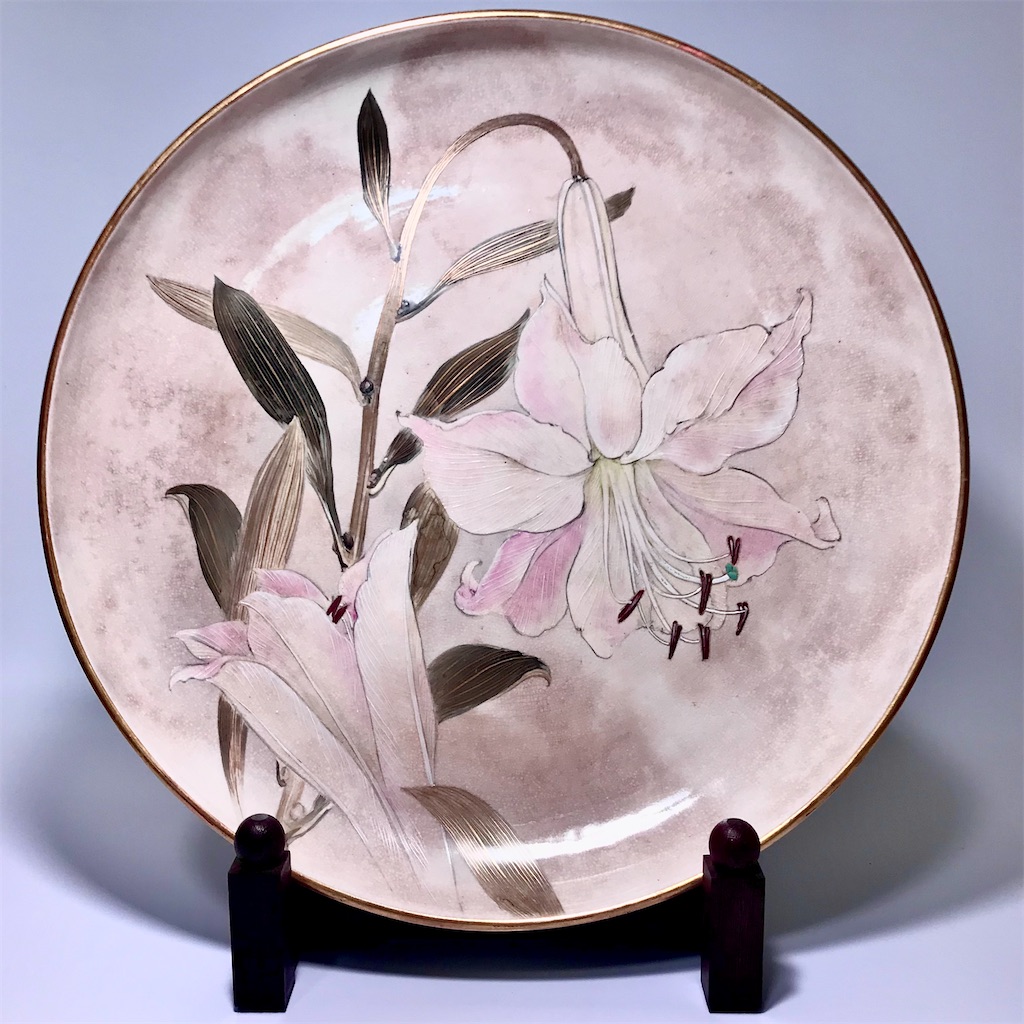
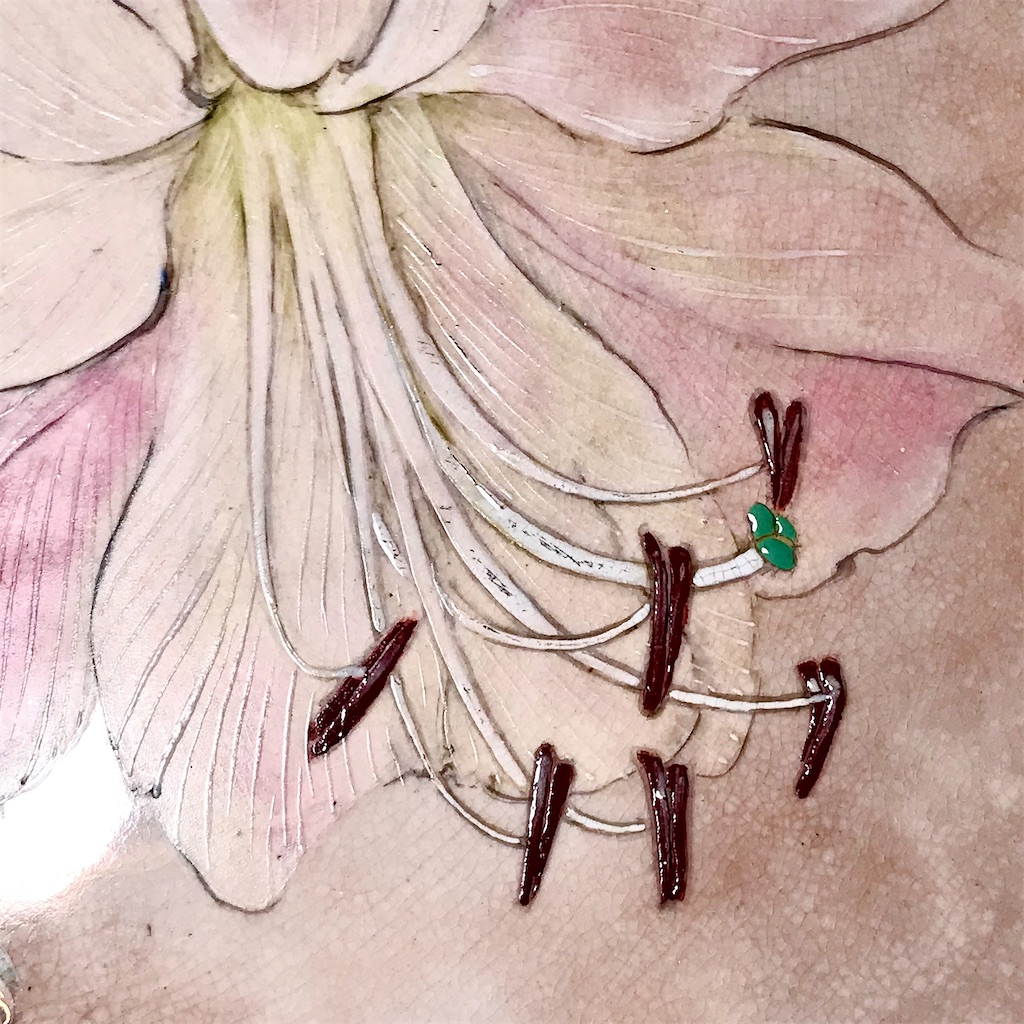
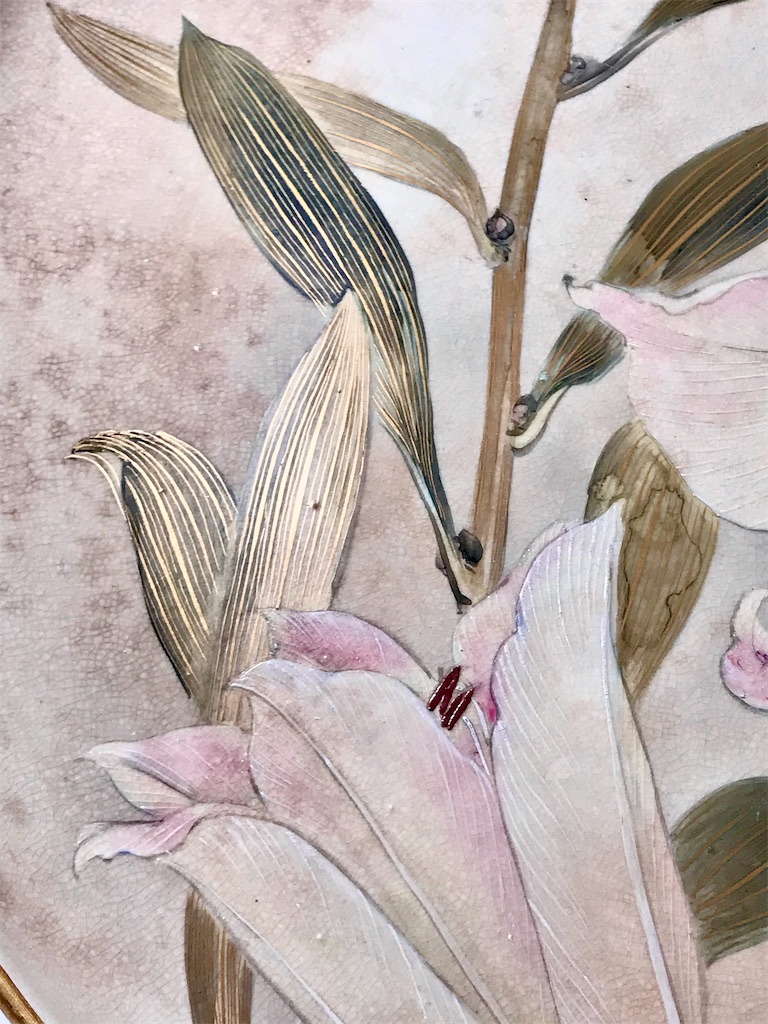
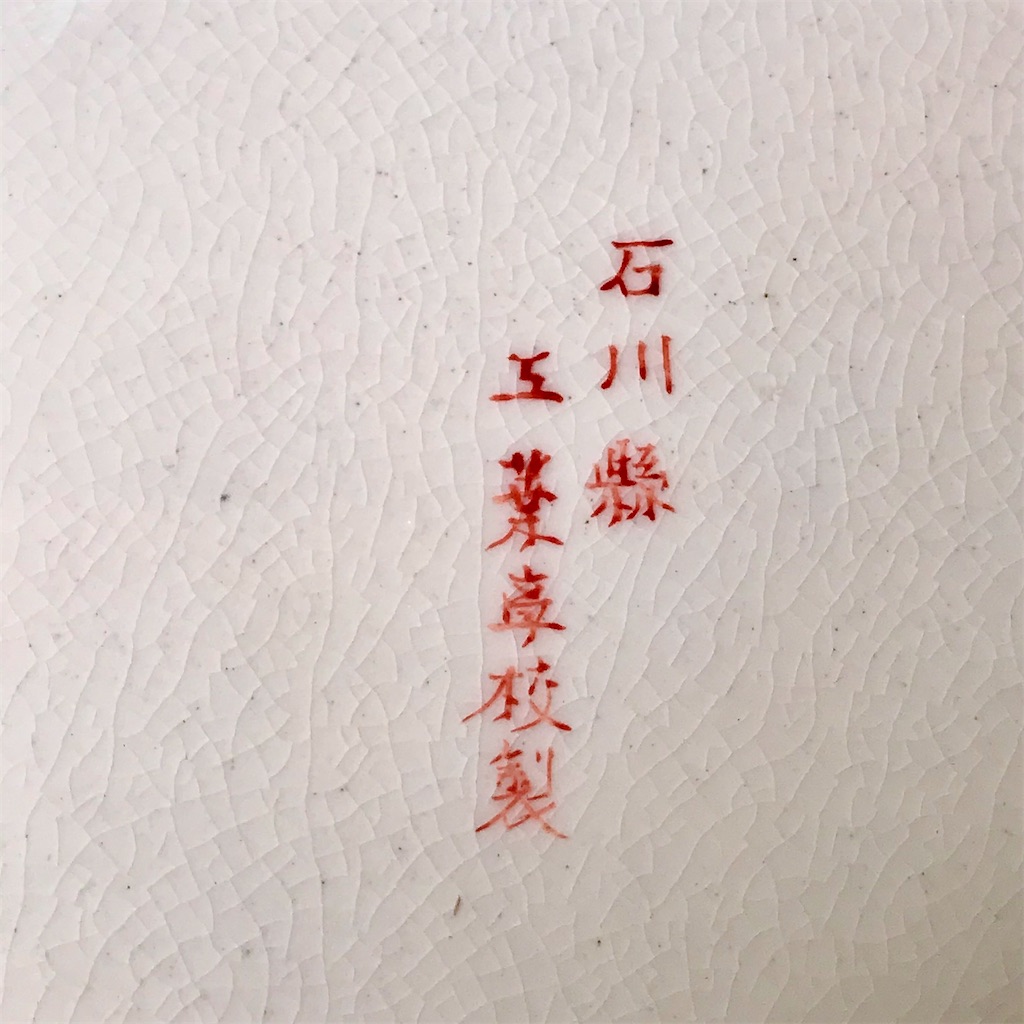
さて、今日ご紹介するのは、明治時代に石川県工業学校が作成して、アメリカに輸出した上絵百合文大皿です。石川県工業学校は、明治20年に佐賀県出身の納富介次郎が創立した工芸学校であり、当初は金沢区工業学校と呼ばれていました。石川県工業学校と呼ばれていたのは、明治22年から明治34年の期間ですから、この大皿もその期間に作られて、アメリカに輸出されたことになります。高台にはアメリカの当時の輸入許可ラベルの破片がついています。この石川県工業学校の教師には、友田安清・諏訪蘇山・北村弥一郎・竹内吟秋・板谷波山などの錚々たる工芸家・陶芸家がいましたから、学校名で造られた品物にも、これらの教師たちのいずれかによってつくられたものがあるようです。
この大皿の見込みにも経年のシミが多くありますが、これを汚れと見るか古色と見るか。私には、良いオーラを出しているように見えるのですが、如何でしょうか。


The phrase “koshoku-sōzen” (古色蒼然) typically evokes an image of something extremely old and faded, and at first glance, it may not seem like a particularly positive description. However, in the world of antiques, especially in Japan, it doesn’t carry a negative connotation.
For instance, in the world of Japanese antiques, one might say something like, “The stains on the interior of this Ido tea bowl have become a beautiful landscape (keshiki), haven’t they?” Here, the word “landscape” refers to the aged appearance, much like koshoku (the beauty of age and use).
Similarly, in the world of Western antiques, one often hears the phrase “Nice patina.” While patina in the narrow sense refers to the greenish film that forms on copper and bronze over time, more broadly, it means the character and elegance that come with age. In this sense, patina is appreciated and admired.
However, when it comes to humans, we don’t usually say things like, “The spots on your face have created a lovely landscape,” or “Your wrinkles have such dignified character.” Age spots and wrinkles are rarely appreciated in the same way. The same goes for cars — no one says that the rust on a car door, the scratches, or the dents have “developed a fine patina.” So, it’s not limited to humans.
Why, then, is it that in some cases, age and damage are appreciated as koshoku or signs of dignity, while in others, they’re simply seen as dirty or unsightly?
It likely comes down to whether something is regarded as a functional item or a work of art. With functional items — say, cars — there’s an expectation that they should always look new and pristine. Even classic cars, no matter how old, are expected to have polished chrome and brass, and fresh paint jobs. In contrast, items regarded as art are often devalued if touched up or restored, as this compromises their originality. In other words, when something is considered a work of art, its age and wear can actually enhance its value — its koshoku becomes something treasured.
Take Buddhist statues, for example. Many ancient ones were repainted multiple times throughout history. This suggests they were originally seen as functional objects, used for worship and decoration. But at some point in history, they came to be regarded as art, and the grime and signs of age began to be seen as sacred, even awe-inspiring. This means that Buddhist statues underwent a qualitative transformation — from utilitarian objects to revered works of art.
The same could be said for antique ceramics. Pottery from the Muromachi or Momoyama periods — like old Tamba or Shigaraki ware — is appreciated for its patina and age. On the other hand, porcelain from the Edo period onward is often more highly valued when it still looks nearly new. So perhaps, in the case of antique ceramics, the transformation from utilitarian object to art takes about 500 years.
As for myself, having grown old, I sometimes wish I, too, could undergo that same transformation — from functional object to revered artwork. I’d love to hear someone say, “Those spots and wrinkles on your face have become a fine landscape,” or even “Nice patina!” But alas, that doesn’t seem likely. If the lead time to becoming a work of art is indeed 500 years, we humans may never get the chance to make that shift in our own lifetimes.
Still, as Walter Benjamin pointed out in “The Work of Art in the Age of Mechanical Reproduction,” true works of art have an aura — a quality that reproductions lack. So perhaps there is such a thing as aging gracefully, in a way that gives off a good aura.
Now then, the item I’d like to introduce today is a large overglaze dish with a lily design, made in the Meiji era by the Ishikawa Technical School and exported to the United States. The school was founded in 1887 (Meiji 20) by Nōdomi Kaijiro, originally from Saga Prefecture, and was first called the Kanazawa Ward Technical School. It used the name Ishikawa Technical School between Meiji 22 and Meiji 34 (1889–1901), so this dish was likely made during that period and exported to America. A fragment of the original U.S. import label still remains on the foot ring of the dish.
The Ishikawa Technical School had many prominent artisans and ceramicists on its faculty, including Tomoda Ansei, Suwa Sōzan, Kitamura Yaichirō, Takeuchi Ginshū, and Itaya Hazan. It’s said that works produced under the school’s name were sometimes created by these masters themselves.
This large dish has numerous stains in the well of the plate from aging. Whether one sees these as dirt or as a beautiful koshoku — the judgment is still up for debate.
